Thursday, 7 April 2011

Hannah Lowe, The Hitcher

     The summer I was eighteen I stole a sheep.
     It was very late, I’d left a party,
     climbed the wet black hill behind the house.
     Hands sunk in the sheep’s wool, I dragged her through the fields,
     her eyes like small moons that looked straight at me..

These are the opening lines of ‘The Calmness of Sheep’, from Hannah Lowe’s pamphlet The Hitcher, published by The Rialto.  Before going any further I’d better say I’ve known Hannah for a while.  See here for this blog’s policy on reviewing people known to it.  She was on the Suffolk poetry seminar; while there she went for a walk wearing her leopard print coat, and all the sheep ran away. 

The sheep poem may not seem typical of Hannah’s work in some respects – it’s more surreal, and many poems have urban settings – but like most of them it tells a story in the first person that explores emotional truths.  She tends to write long, rhythmical, rolling lines which leave a distinctive music echoing in the head.  Sometimes she uses terza rima to move the narrative down the page, as in ‘Those Long Car Silences’:

        All those long car silences, the miles and miles
        you drove me through this city, strange words lit
        in neon, Lucky House, The Taj Mahal, Halal.

        I kept my voice held back for nothing
        but to punish you.  I see us from the outside now..

This poem, like several others, draws on her relationship with her father. He was a professional gambler, which gives her access to some great material and language, as in these extracts from ‘Chick’.

        Dan said he saw you ironing cellophane.
        I said you’d let me hold a thousand pounds.
        We found a hollow-soled shoe…

        At the funeral, a ring of phlegmy men with yellow eyes
        and meaty skin.  They told me what your name meant,
        put the ace of hearts across your coffin,
        flowers shaped as dice.

Hannah writes about relationships, love and grief.  The poems are often filmic in effect – road movie, when they involve a journey – full of movement, colour and things happening.  This can give the reader that drunkenness-of-things-being-various feeling, as in ‘Room’.

        I turned twenty-one that week and dialled
        my mother from a greasy booth along the Boulevard,
        sobbed soundlessly into the static fuzz as punk-haired girls

        flew by on roller skates, a tramp with tattooed stars
        under his eyes was thumping on the glass.  An orange Dodge
        pulled up and I climbed wordlessly into the car

        beside a man I’d seen somewhere before.

A lot of writers mining this kind of seam would come across as self-consciously edgy or hip, and would probably get praised for it.  For me part of the core appeal of these poems is their directness and lack of ego: they employ irony but aren’t clever, edgy or flaneurish.  This is from ‘Fist’, a poem in one long block.

        This was Ilford, Essex, 1993, nearly midnight,
        us all smashed on booze and Ecstasy and Billy,
        6 foot 5, folding at the knee, a shiny fin of glass
        wedged in his wrist…
…  I got down, I knelt there on the ice
        and held my brother, who I never touched, and never told
        I loved, and even then I couldn’t say it
        so I listened to the incantation easy fella..

In an interview on Jen Campbell’s blog here, Hannah says she reads a lot of American poets and Philip Levine is her greatest inspiration.  The American influence comes across in the wideness of her writing, the ease with which she flings out her long lines and narratives.  

For now at least, that ease may be linked to her use of the first person.  All the poems have an ‘I’ or (occasionally) a viewpoint close to that, except for ‘English Widows in Beautiful Gardens’ which I found to be among the few less successful; it’s well written but the subject matter feels more conventional, and the compelling, truth-telling tone isn’t there.

Hannah uses form well; the terza rima, and sonnets.  This is from the lovely sonnet ‘Foxes’:
       
        My newest bra is hanging on the headboard,
        makes a shadow-rabbit on his ceiling.
        We mix our noises with the foxes until dawn..

I can imagine her doing a lot more with form in the future.  She is in her mid-30’s and has only been writing for a few years.  It will be very interesting to see what she writes next. 

The pamphlet looks really good – it’s wider than most and beautifully designed; The Rialto has done Hannah proud, though I wish it knew the difference between it’s and its.  She did the magazine proud at the launch last week, upstairs in a packed Kings Cross pub. 

I’ll end with the end of that sheep poem.  It reminds me a bit of Elizabeth Bishop’s Sestina, with whose form it has something in common.

        and even now that night comes back to me –
        her wool and the wet black fields
        that I sometimes watch from this deafening house
        where there are always parties
        and never the calmness of sheep.

To find out how that form is sustained throughout the poem, and where the togaed man on the pamphlet’s cover (bridge pier, near left) wants to go, you can buy The Hitcher on The Rialto’s website, here. 
       

Wednesday, 30 March 2011

Mayo Tao, Suffolk Tao. The Poetry Trust's lost grant

              I have abandoned the dream kitchens for a low fire
            and a prescriptive literature of the spirit;
            a storm snores on the desolate sea.
            The nearest shop is four miles away –
            when I walk there through the shambles
            of the morning for tea and firelighters
            the mountain paces me in a snow-lit silence.

That’s the beginning of Derek Mahon’s ‘The Mayo Tao’, a favourite poem.  I love the way he both embraces the experience and stands self-mockingly outside it; and the delight in language, the lines rolling out like sea and mountain (but contrasting clipped ‘i’s in line 2).   Later on, he listens to the ‘sob story’ of a stone in the road ‘for months’, which as well as being funny makes you think of the history Irish roads have seen.  Then there’s the instant conjuring-up of the outside world in ‘dream kitchens’, which brings to mind those Irish haciendas and colonnades of the 80s and 90s.  Isn’t there an Irish song about them? 

And there’s the last line quoted above, which conveys exactly how a mountain is when you walk below and alongside it – it really does pace you like a silent companion.  The photo below is taken from near the summit of Blaven on Skye: Glen Sligachan, the long, long valley in the background, is a place where the mountains do that.


I'd have used an Irish one, but my Irish photos are all pre-digital.  There isn’t any rain in The Mayo Tao, despite its Irishness.  No rain: the dryness of March goes back as far as the Canterbury Tales’ opening two lines –

            When that Aprill with his shoures soote
            The droghte of March hath perced to the roote..

According to the note in the Riverside Chaucer, the ‘droghte’ of March ‘has been attributed to literary convention but is a fact… a dry March, necessary for sowing, promised a good crop’. 

It was wishing I was still in Suffolk that took me back to the Mayo Tao.


Here is the view from my window at Bruisyard Hall, where we stayed for the Poetry Trust seminar.  There was a windowsill big enough to sit in, and a rookery (dead poets heckling?) in the trees on the left.  The weather was like this most of the time, dry but misty; and the drive looked like this, empty, except for us in ones or twos going for a run or a walk, or (Michael Laskey) a bike ride. 

Michael gave us The House by Richard Wilbur in one of the workshops – for its craft, space and effortlessness, and as an example of how a poet can write and write until at last the ego goes away.  Some of that writing and writing happened at Bruisyard Hall.  It’s a shame that this, and the perceived need to promote oneself to get published etc, seem to lie at opposite poles of states of mind.

The week after the seminar I visited the Poetry Trust in their eyrie at the top of The Cut, Halesworth’s old maltings converted into a cultural centre.  There are some nice Suffolk towns and Halesworth must be one of the best – a railway station, a Wednesday market, The Cut, two bookshops, pubs, a river, the sea not far off, and poetry with a birds-eye view of everything.  All it lacks is a mountain… 


Blythburgh marshes: angels in church, horizon left
I hope Halesworth doesn’t lose a bookshop, as that day the one opposite the church was taped off with red-and-white Fire Brigade tape, and when I leant over it to look through the open door, there was a smell of wet ash.  Burglars had hacked out the safe for £500 and set light to some books.  The bookshop shares an entrance with a carpet shop, and I couldn’t help comparing the value of their respective wares, not to the benefit of carpets.  From the other, second-hand bookshop I got The Enthusiast’s Field Guide to Poetry: quirky in a good way.  Ideal present for someone who isn’t sure what he/she thinks about poetry, but is prepared to try to find out.  The author is anonymous – I wonder what ego score that gets.

I also hope Halesworth doesn’t lose the Poetry Trust, which today lost its Arts Council grant, about one-third of its income…  Unthinkable that we could do without the Aldeburgh Poetry Festival, the lovely website, the Poetry Channel, the Poetry Paper, the outreach work, all delivered by a handful of dedicated people.  I suspect that the Poetry Trust has developed organically, doing what work it sees is good, rather than conforming to logical frameworks or external criteria.  Arts bureaucrats may not like that, but surely it’s what arts organisations should be free to do, without fear of falling.  Are there any rich, poetry-loving philanthropists out there, please? 

Sunday, 20 March 2011

Suffolk: birds, reeds, Hölderlin and Bruisyard


photo copyright Ashley Dace

I’m staying on the edge of Blythburgh, a few minutes’ walk from the marsh on the River Blyth estuary.  Have just been there to see what birds are around at dusk.  There’s a bird-hide down a path through the reeds.  I wish I’d brought the connection that downloads photos from my camera; as I haven’t, this is someone else’s photo. 

Mostly it’s a bird-city here, even a gull-slum – but just now, though it’s low tide, there were only a few: an avocet taking long-beak swipes at its own reflection in the mud; a backing group of 3 more (oh, they are so sweet); a curlew whose white-underneath tail end made it look as if it was wearing a too-short tutu each time it upended to jab the mud; a few shelduck showing up well in the dark; some redshanks; a few smaller waders hard to see but maybe dunlin; and a helmet-like duck head that when the rest of the bird emerged would have been exotic, except that it was a mallard. 

When I lifted the binoculars to look at the far shore, I was startled to see giant black shapes lumbering along, which were cows. 

By the way, I’m not a bird expert but like watching them, it’s a way of getting transported somewhere, not quite sure where...  I have also seen some bearded tits!  Yes, that’s a bird, believe it or not – and rare, they live  in the reeds. 

As it gets darker, the washed-out reeds turn brown, bright brown in contrast to the grey water/mud/sky.  Yesterday morning around high tide, they were cracking – the sound came from the waterlogged ground they grow out of, so must have been made by the water coming or going.  It was like standing in the middle of a bowl of Rice Krispies. 

The sound reminded me of Hölderlin’s poem ‘Hälfte des Lebens’:

         Mit gelben Birnen hänget
Und voll mit wilden Rosen
Das Land in den See,
Ihr holden Schwäne,
Und trunken von Küssen
Tunkt ihr das Haupt
Ins heilignüchterne Wasser.

Weh mir, wo nehm ich, wenn
Es Winter ist, die Blumen, und wo
Den Sonnenschein,
Und Schatten der Erde?
Die Mauern stehn
Sprachlos und kalt, im Winde
Klirren die Fahnen.

I cut-and-pasted this from the internet, hope it’s right, can’t check until I get home.  ‘Fahnen’ usually means flags, but the experts think here it may mean weathervanes (usually Wetterfahnen I think, am hampered by lack of German dictionary, not sure how far to trust online ones).  I translated this poem a while ago (because I love it) and wondered if in this context it could mean reeds or rushes.  ‘Klirren’ means clatter, rattle, clink.  And reeds do rattle in the wind, as anyone brought up in the Fens knows; and I wanted to be taken back to the lake.  Now I know reeds can also go snap, crackle, pop. 

        Half of Life                                         by Friedrich Hölderlin

The land with yellow pears
and full of wild roses
hangs down into the lake,
you lovely swans,
and drunk with kisses
you dip your heads
into the pure and holy water. 

But where, oh where shall I find
the flowers, when it's winter, and where
the sunlight,
and shadows on the ground?
The walls stand
speechless and cold, the reeds
rattle in the wind. 

That’s how I translated it.  Thanks to a commentary on the poem by John Irons, here, I’ve found out that David Constantine and Michael Hamburger, who both know a hundred times more about this than I do, have weathervanes or weathercocks respectively, and clatter as the verb.  So that must be right. 


photo from blythburgh.net
Here’s an angel from Blythburgh church, cathedral of the marshes, a very beautiful church so full of light that it seems to float when you’re inside.  Angels are all along the middle of the timber roof rafters.  She (I think it’s a she) may be praying to avert the next flood.  Several of the footpaths I’ve tried walking on have been closed because of flood damage, or for repairing flood defence works; or are signposted for humans but navigable only by  oyster-catchers and wigeon.  The River Blyth runs just below the church, so I hope she is praying really hard.

The reason I’m here is that I spent last week at a seminar organised by the Poetry Trust, bless them, at Bruisyard Hall near here.  Eight of us were extremely spoiled for five days, tutored by the incomparable Michael Laskey and Peter Sansom (hardly need say that the adjective is meant for both).   We all had a lovely time, and I think everyone wrote quite a lot… anyway, there must have been something in the water, or air, or Maggie’s amazing cooking, because for the first time ever I was able to write in workshops.  Usually, even if surrounded by people I know a bit, I just can’t do that. 

So I’m staying up here in order to write, in the hope that more of the magic will stick than would at home.  So far it’s working, touch wood, despite cold-but-soft spring weather and a cottage with lots of books in it, from Dostoyevsky to Woolf, le Carré to Christie, and much else including Do Cats Need Shrinks?, Death by Spaghetti and St Bridget of Sweden.  Plus one of the few Rebus books I haven’t read, which I’m going to read now as an antidote to poetry.  And dvds, and a rather dodgy internet connection which wasn’t working when I wanted to post this earlier. 

Wednesday, 9 March 2011

Philip Nikolayev: Letters from Aldenderry

These poems are clever, piss-taking, lyrical, experimental; often all at once.  It might help to have a PhD in semiotics when reviewing them. 

Philip Nikolayev is a Russian American, born in Russia in the 60’s, moved to the US in 1990.  As one poem suggests, he was fluent in English from childhood.  Not that I’d take his poetry as a reliable source of information, but this is backed up by the publisher (Salt)’s blurb.  The English, Nikolayev says in ‘The Next Level’, came from translated Russian folktales, the BBC, and “brainwashing” from Radio Moscow’s own World Service.  No wonder he plays games with language.    

There’s a sort of demented rhyming strangeness about the poems which might come from reading poetry and writing it in a second language, especially when he’s fooling around. Some poems read like a cross between a poetry-writing computer and Lewis Carroll.  ‘On Falling Asleep in August Hot Wee Hours’ starts:

           With diminishing bias psychological science offers greater reliance.
 We prefer to dull waiters whereof we are patrons shrinks to whom we are clients.
      
                  
It includes the verse

        In untidy dreamy halls
        duty calls like nature calls,
        through the kitchen window falls
        to the ground and breaks its balls.

Oh, and it contains woods, and ends ‘I have no promises to keep’...

For me the most rewarding poems are the ones where he really lets his lyrical self rip; and the embedded sonnets, of which there are around 40.  I’ll quote one of the latter in full – just typing it out is going to be a challenge.   [I've had to reduce the font size to make it fit.  The right-hand side should be justified, but it refuses to come out that way.] 

     A Quarry of Words

     My city is very small, but I own it.  Battalions of brazen brass could not
     destroy it if it saved their ass. Ministering to their wounds, they must be
     joking,  militarily  speaking,  but I simply open my umbrella and the
     Obscure as rage, the willow clings to clay,  wind blows them away,  from
     an avalanche of twigs in sharp display,   here to Hollywood & to,  via the
     The mast is wedded to the mist,  the mist movies and the movie trailers,
     hangs on modalities of may and must.    Uttar Pradesh.    Monkeys galore
     Mute and astonishing, the crested moon     catapulting from banyan trees
     swings brimming on the strings of Humayun      shoo them away and bite
     and rattles like a keg of flotsam honey off their determination.   (“Shooed
     delivered on a tong of surplus money.  by Monkey Folk.”)   Delicatessenly
     I, co-enslaved and collared by the bay,  Firdousian, the elevator, it clicks,
     forever groan and grope at what to say,    disadmitting us into a pushcart
     diving through rocks to palpable solutions.   lounge,  filled with chilled tea
     Only the quarry wants my revolutions.  urchins, comfits on yodel platters,
     Dry ether fills the hollows of the earth.   a helter-skelter caboodling down
     Creative life, acute mineral dearth.  riverside stalks, so.  I happen to have
     tomorrow.  After all those discomfortable positions (in threads)– freedom!
     Stay alert and wish you were always here,with meaning.With no meaning,
     why would we wish to stay?   Ahoy, life opens a new book to an old page!

Whew.  I found I typed this a bit like I read it – at first going all across the page, trying to continue like that as the sonnet in italics starts, and finding this so difficult that I read/typed the rest of the sonnet first, and then the prose side.  (I call it prose to distinguish it, but of course when the sonnet starts the prose poem moves towards free verse, though I don’t think it quite gets there, and then back at the end.)  The eye and the mind, as if pre-programmed by what’s familiar, nursery rhyme plus 17th/18th century rhyming couplets, get drawn by the sonnet’s full rhyme and clear syntax, and its weird atmosphere like some scene from Conrad. 

By the end of the reading, there is a Grand Canyon between the sonnet and the rather post-modern prose poem (which in some of the other embedded poems is more poetic than here).  What do they have in common?  Estrangement, the sonnet in one location and the prose in many?  Maybe the two halves need each other: without the prose, the sonnet’s archaising doggerel might be too much (it feels a bit like one of those old-fashioned translations of some famous ancient poem) and without the sonnet, the prose might just be a word quarry.  Flowers and weeds; emperor and clothes… 

The reader ends up feeling two parts of her literary mind have been spliced, and wondering where the poet will take things next: answer, to another such poem, but with variations.  It’s fun, sometimes laugh-out-loud funny.

This 122-page book could have been shorter.  Some of the more discursive poems are distinguished by their energy and use of language, such as ‘Homage to Paradox’ which starts

        Some moments are not best served by self-explication,
        nor by ancient self-justi- or –purification
        nor by Romantic self-atonement,
        nor by self-anything-at-all.  They are Zen
        moments, neither “nor” nor “or”..

and so it goes on.  Others can become a bit gratingly clever.  Some of the shorter poems are no more than doggerel to me (though one reviewer, see below, says one is a translation of a Russian nursery rhyme).

As for subject matter, all modern life is here, from computer-speak to dilemmas, domestic living to high and low finance.  ‘A Fund of Hedge Funds’ includes the sentence: “Financial risk is interesting, / because ultimately risk indicators are non-additive.” ‘A Secret Open Secret’ starts “If you have a car you need to park it. / Therefore, parking is also a market.”  The whole of ‘Cicadas’ reads:

        Wife’s figured out how to turn off cicadas.
        She whistles, they shut up.  Damn,
        how do I turn them back on?

There are poems about his Moscow and Moldovan past, “free / in the grip of that greatest paradox of all - / a happy Soviet childhood.”

On first reading, I found Nikolayev’s language made such an impact (not always positive, as should be clear by now) that it tended to obscure the subject matter.  Several readings are needed to get the most out of the collection.

My favourite poem is the last one, a plain sonnet, ‘Earth’, which ends:  

        Staring at nature helps him to forget,
        to come to terms, to cancel out the debt.
        All night he whistled with a mockingbird
        and now on his old keyboard types a word
        or two into the world and falls asleep.
        The land has willows, something needs to weep.

It seems that everything comes together in this poem – the lyrical sense, the almost frenetic facility with rhyme and metre, the surreal playing around, the parody.  What a lovely last line.  And the elegiac tone seems to cast its shadow back over the collection as a whole, which is full of uneasy sadness as well as funny and weird stuff. 

Letters from Aldenderry is published by Salt. I got it out of the Poetry Library, but I’m going to buy it, I want instant access to its strangeness.  And Salt need the support of course. 

There are some reviews online, the only one I’ve looked at is in Jacket, here, by a Russian - which gives an interesting angle - and reproduces a couple of the embedded sonnets. There is a very absorbing and erudite review of Nikolayev’s earlier book Monkey Time in Jacket, here, also with some generous quotations.    

Thursday, 3 March 2011

First collections; and form in contemporary American poetry

Rob Mackenzie recently posted on his blog this excellent passage from WN Herbert, on first collections.  Originally from last autumn’s Poetry London, so it’s now been recycled twice.  And deserves to be so many more times.  It’s the kind of thing you read, think about and measure yourself against.  And then re-read, a few weeks later, which is what I’ve just done. 

***

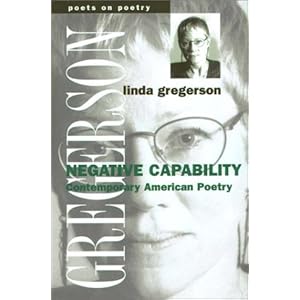
I’m reading a book by the US academic and poet Linda Gregerson, called Negative Capability.  It’s got some interesting insights into contemporary American poetry, and more widely, especially in the introduction where she talks about form. 

First, the title took me back to that passage in Keats’ letters; apologies if you know it by heart, but it can never be quoted too often: 

.. Negative Capability, that is when man is capable of being in uncertainties, Mysteries, doubts, without any irritable reaching after fact & reason…

From a letter to George and Thomas Keats, 21 Dec 1817.

Anyway, Gregerson considers negative capability, and Keats’ rejection of poetry ‘that has a palpable design on us’, in relation to her subject.  She comments that

This palpable design has modulated, I would argue, into one of the great semantic and tonal resources of contemporary American poetry, most palpably when it stages its own undoing… [It] may not be long on fact and reason of the sort Keats had in mind, but it is filled with irritable reaching. 

And goes on to talk about form.  I’m quoting this at length because I think it’s interesting, and relevant to the reading and writing of any contemporary poetry.

Negative Capability: Contemporary American Poetry (Poets on Poetry)Form in the strong sense is not ‘received’; it is invented.  Form is not the dead hand but the living measure of tradition.  And, despite recurrent accusations [she fingers the Brits; this was in 2001, would she do so now?], form has not gone missing from American poetry.. Form has modulated in multiple, and often extravagant, directions, but the formal imperative of most consequence in contemporary American poetry has a single, recognisable center: one must learn something new in the course of writing a poem.  That is to say, the medium itself must be mined for its insights, the language used in all its material reality as an instrument for inquiry.  To report in a poem on what one has learned or felt elsewhere, to paraphrase some other mode of being, to end where one began: these are the hallmarks of formal insufficiency.  One enters a poem to be changed.  These strictures are hard to adhere to; they may be hard to distinguish from nearly plausible imitations.  But even traditional templates may be reinhabited as though they were strange and new...  Rhyme and rhythm, diction and voice, the image made to work as argument, argument made to work as pacing or dynamic, the modulated tensions between one phrasal unit and another – all are the elements of form, and all may be used as ways of putting the question. 

I’ll add the examples she gives, as they help make sense of the argument and some are interesting descriptions in themselves:

William Meredith’s ‘reinvention of the sonnet’
Gjertrud Schnackenberg’s ‘reenchantment of rhyme’.  
‘Multiple pitches of diction and voice’: in the ‘talking lines of James Schuyler and CK Williams, the ‘fierce vernaculars’ of Muriel Rukeyser and Philip Levine, Heather McHugh’s ‘back-talk’ and John Ashbery’s ‘urban riff’. 
‘Governing logic’ of image in Jane Kenyon, Mark Strand. 
‘The momentums of argument may be used with as much detachment, and as deftly, as if they were anapests and tetrameters: see Louise Glück.’
‘Contours of syntax and line’ generating subtle music: Glück again.

Wednesday, 23 February 2011

Review: Interior with Sudden Joy by Brenda Shaughnessy

If you want different poetry, here it is.  Brenda Shaughnessy’s first collection, published in 1999, communicates the shock of writing something not written before.  It’s hard to describe her poems in prose.  This is how the book ends:


I am ever stunned,
seduced whistle-thin

& hot with home.  Breathless with
mercury, columbine.  Come, let us miss
another wintertime.

That’s from the title poem.  The poems are all interiors – set indoors, love poems, exploring states of mind and the psychology and practice of love and sex, pleasure and pain.  Many are addressed to a ‘you’, who (when anything) is female, but could be one or many – plot doesn’t signify.   The language, often contained / released by couplets or triplets, is lyrical, erotic, funny and highly baroque, and may get you looking up words.  ‘Jouissance’ begins like this –

        Your phantoms hang neatly from skyhooks
        ready to be veils, ready to disembody you.

And includes this passage:

        Electric to perishing, your more auxiliary lovers,
        like pralines or quaaludes, cannot touch you.

        No teasing or lockjaw. Caustic.  All of you, even shadow,
        must be bull’s-eye. Your shaggy, skeptical

        quasar has died the way Andromeda dies:
        so very late at night.  You are disenchanted.

Influences surely include Plath, Ashbery and O’Hara – and those are just the ones I know about and thought of.  Shaughnessy’s tone is both ecstatic and knowing.  She flings out strings of impossible associations.  These seem weirdly wonderful, often erotic:

What’s Uncanny

is the body’s wiry edge singed & dried,
touched at last by the curious

gloves of the question guard.

Sometimes they drown in their own eclecticism.  It’s as if there’s too much stuff in the writer’s head – from history, mythology, astronomy, wherever – all fighting to get into a poem.  Here’s a passage from ‘Arachnolescence’:

        I’ve won the tourniquet, I’ve devastated toddlers
        in the height of their podlike fashion, in their pink-naped
        heaven of Erasmus and his near-wife, Chlamydia.
        Give me five years, lovers, I will give you the ancient torture
        device constructed of kisses, in the glum transfusion
        of crisp, lichen climate with rectangular erotics.

To me, the last three lines of that really get something across; but their impact is lessened by the stuff in the first three.  Toddlers, Erasmus and chlamydia?  Am I missing something?  if it’s just a piss-take, I don’t really care – don’t find the language or content interesting. 

I love the simplicity of these opening lines from ‘Your Name on It’ –

Let this one clear square of thought be just
like a room you could come to in.

Where the poem goes after that subverts expectations, and seems easier to do, however vivid: 

Let this one clear square of thought be just
like a room you could come to in.  An attic room,
after you’ve swiveled over to the wrecked
corner of the champagne.  After you

hand-rolled cigarettes and ass and sold
your best midnight speech to a slick jack
of clubs.  For a stingy cut: a wet, bony
kiss. 

A few poems are on different themes, like ‘Lacquer’, which starts:

        I found my mother’s diary
        an indigo sac of silk and ink.
        I read it.  The words in Japanese
        but the characters as American
        as a girl of fashionable twelve
        bearing an amnesia so dense
        she could never drag it
        out into the yard.

This seems a deft way to describe the hidden difficulties of assimilation; this poem made me hope she’ll write more stuff like it.

I first read Interior with Sudden Joy about a year ago, and loved the way the weirdness of the language and associations got my synapses going, often misfiring pleasurably with half-understandings.

Reading it again now, maybe my expectations were too high.  There are places where I get glutted on words, and lost without being interested enough to enjoy it.  But then I come to another synapse-misfiring bit, like this opening of ‘Ever’:

Where, swift and wool in going?
Fell always wishing like this.

Shaughnessy says in an interview that the choice of writing poetry "seemed to offer the simultaneous and attractive possibility of being deeply understood and completely misunderstood”.  (From Princeton University’s website, where she teaches.)   This is a great quote, which illuminates the book.  Whatever understanding does come from reading the poems is not at the level of ordinary consciousness.

Interior with Sudden Joy, published by Farrar, Straus and Giroux, New York 1999.  Costs £6 on Amazon UK.  Shaughnessy has a second collection, Human Dark with Sugar, 2008.  Both are in the London Poetry Library.