Thursday, 31 July 2014

Holiday reading, for those who do and those who don’t read poems: The Enthusiast Field Guide to Poetry


If a house is an extension of its occupant’s brain, then when it gets turned upside down, the brain is affected too.  Especially if books are involved.  Last week all my books were crowded into two smallish bedrooms, while downstairs the plaster was hacked off and replaced, and a damp course put in.  The ceilings haven’t collapsed – not yet.  There’s more work going on this week. 

Domestic surrealism isn’t all bad: upturned chairs on the spare bed, a bath on the sitting-room floor.  Things that I’d forgotten have reappeared, including this book. 

I bought it in the second-hand bookshop in Halesworth three years ago, after going on the Poetry Trust’s Aldeburgh Eight seminar.  I don’t know which page I opened it at, but I remember being intrigued by its difference.  The anonymous authors describe the book as “a conversation on the possibilities of poems”.  It consists of 150 texts, mostly poems but some prose, each followed by a short and plain-worded comment, often quirky, or insightful, or both. 

Here’s a sample from several consecutive pages, to try to show what the book does.  On one side is an extract from a Gerard Manley Hopkins letter:

One of two kinds of clearness one should have – either the meaning to be felt without effort as fast as one reads or else, if dark at first reading, when once made out to explode. 

The commentary quotes Hopkins’ ‘The Windhover’ as an example of exploding clarity. On the opposite page, for the other sort of clarity, are around a dozen lines from Ezra Pound’s ‘Canto 49’:

Comes then snow scur on the river
And a world is covered with jade
Small boat floats like a lanthorn,
The flowing water clots as with cold. And at San Yin
they are a people of leisure. 

..the equal distribution of emphasis, so that on each and every thing the poem, as it were, sheds its light… This is the value of free verse. In the absence of metre the poem’s emphasis falls everywhere. Everything, so Pound would have us believe, is illuminated. The key element of poetry, he argued, is light.


A poem about looking, a poem attentive to its own attention, which wanders, and in wandering, stumbles across things. 

And then Charles Olson’s ‘May 31, 1961’ which starts,

the lilac moon of the earth’s backyard
which gives silence to the whole house
falls down
out of the sky
over the fence

                                 poor planet
                      now reduced
                      to disuse

Here there’s a commentary that takes in Whitman’s lilacs on the dooryard, Ashbery’s “the lake a lilac cube”, and the making-it-new effects of spacing, “the way, in the poem, the attention falls”.  The next poem is ‘In Leonardo’s light’ by Lorine Niedecker, a different shape of falling; and so on.  

It’s this juxtaposition which enables many of the insights:

What the book believes very strongly.. is that poems are, among other things, commentaries on other poems, that poems are readings, that poems enable the possibilities of other poems.

The book ranges from Homer and Sappho to Dickinson, Apollinaire, Empson, O’Hara; and Ashbery and Hill, two of only a handful of living poets represented.  Very much the western canon, though including several American poets I’m not familiar with; and nearly all white male.  Can I forgive the authors for leaving out Elizabeth Bishop?  They need to write a sequel.   

The prose includes Wordsworth and Pound, but also William James (1892) on streams of consciousness and an extract from I A Richards’ Practical Criticism, listing ten difficulties, from mnemonic irrelevancies to stock responses and inhibition.  There’s a quote from Nietzsche on poets, including:

    A little voluptuousness and a little tedium: that is all their best ideas have ever amounted to.
…
    They are not clean enough for me, either; they all disturb their waters so that they may seem deep!

And there’s Muriel Rukeyser’s sonnet ‘Homage to Literature’:

then stare into the lake of sunset as it runs
boiling, over the west past all control
rolling and swamps the heartbeat and repeats
sea beyond sea after unbearable suns;
think: poems fixed this landscape: Blake, Donne, Keats.

[Commentary]…The only true homage to literature is literature, which is to say, doing something.

Whether or not one agrees with all the commentaries (and surely half the point is to disagree, thus carrying on the conversation), this waymarked trail of poetry and poetics is entertaining and thought-provoking to follow.  Some or many of the texts will be familiar to people who are versed in this stuff, but that’s fine.  The effect is like having one’s library, both physical and in-the-head, turned upside down and reassembled differently. 

Above all, The Enthusiast Field Guide to Poetry would make a perfect present for anyone who’s interested in reading, and ideas, but doesn’t read much poetry and maybe doesn’t ‘get’ it.  The fragmentary format also makes it perfect holiday reading.  The book has an order, which doesn’t need to be followed.  It has a perfect last poem, ‘Salute’ by James Schuyler, too perfectly brief to quote part of, better to go to the whole.

The Enthusiast Field Guide to Poetry was published by Quercus in 2007.  It’s not on their website, hence the Amazon link, which normally I’d avoid giving but it shows plenty of copies.  If you’re curious about the learned authors, one of them is easy to identify by googling; I’ve no idea who the other(s) are, though the writing style sounds uncannily like someone I know.  To end, here’s a definition of theirs:

A poem is an arrangement of words containing possibilities.

Tuesday, 15 July 2014

God Loves You by Kathryn Maris


Why people believe something tends to interest me more than the detail of what they believe.  That’s certainly the case in this week of women bishops, when some Church of England women spoke out against the proposal during the Synod debate.  The deeper reasons that come to mind are psychological rather than theological, and I’d love to come across a play, a novel or poems that explored them. 

God Loves You  is full of states of mind both contemporary and ancient, in language and rhythms to match, the ancient ones drawn from the Bible, authorised version.  This combination may be why the book got under my skin.  It’s not like any other book.  I’ve wanted to write about it for a while, but was inhibited because I know Kathryn Maris.  I’m writing about it anyway.  That’s a dilemma Maris’ droll, agonised, slyly confiding voices could dramatise perfectly, though they are concerned with more fundamental issues, often sins both great and small: jealousy, spying on neighbours, rivalrous parenting, husband-stealing. 

The biblical angle can allow a speaker to come straight to the point, while also making old truths about human nature sound new, as in the opening lines of  ‘Why I Will Gladly Take Your Man Away’:

Because there is time
and because I can claim Him and then declaim
to you, ‘I know not what I do’, 

The capital H is no accident; God can get mixed up, mostly with  husbands etc, and this speaker goes on to say:

if you’ve got God, then watch Him hard
because I will take Him if I can

So religion gets sent up mightily, along with our more secular preoccupations.  The book, which is carefully ordered, has an epigraph from Ted Hughes: “Crow realised God loved him – / Otherwise he would have dropped dead / So that was proved.”  The middle section contains several prose poems in biblical verse form, full of surreal truthiness.  Women carry boxes full of grief or demons and meet men, angels, kings, God.  Bible stories meet folk/fairy tales, with a dash of William Blake.  From ‘God Loves You’:

4. On the second day, there were finches  
in the air.    I saw with my own eyes this
flock yield the form of a heart before me.
5. The next sign, too, was full of meaning.
It was a sign.   And it was revealed to me
thus: the Damut Estate. And in that name
I read these words: ‘Deus te amat’.

That’s a fairly harmless example, but underneath the arbitrary twists and turns in some tales there lurks something nastier, the logic of the witches’ swimming test.

Maris uses form expertly.  Iambic pentameters in ‘Will You Be My Friend, Kate Moss?’ convey breathless celebrity-worship. The premise of the poem is that both KMs have daughters in the same ballet class.  This mother’s thinking like a smallish girl:

We have so many things
in common, like you’re pretty much my age;
we share initials; the circumference of
our thighs is basically the same. (I checked.)

A sestina, ‘Darling, Would You Please Pick Up Those Books?’ is in the voice of a wife complaining about her author husband’s muse – the form works its repetitions round and round her desperate jealousy, like the hoovering which is the starting-point for her complaint. 

do you have any idea how it feels
to step over books you wrote about her
bloody hell you sadist what kind of man
are you all day long those fecking books

in my way for 3 years your acclaimed books
tell me now what do you have to say
for yourself you think you're such a man
silent brooding pondering at the floor
pretending you're bored when I mention her

The poem can be read in full here, with a commentary from Carol Rumens.

Then there’s ‘Knowledge is a Good Thing’, a dialogue with the devil, in full-rhyming couplets short enough to be really hard to do (shorter lines = fewer options).  Eve with a echo of Blake’s Songs of Experience, and many novels:
Blake: Eve tempted by the serpent. V&A

‘What’s his is yours.
Look in the drawers.’

‘I’m forbidden
to know what’s in them.’

‘You’re his wife.
Dig up his life.’

‘Will I despair
at what’s in there?’

There is no shortage of emotional extremes in this book.  Individual exposures can be merciless but the overall effect is merciful, because of the empathy – each speaker is revealing us all. 

Some poems tend more towards the spiritual, such as variations on the Greek 20th century poet Melissanthi; and metaphysical, such as ‘The Sun’s Lecture Notes on Itself, You and God’.  This is one of several that start each thought and/or sentence on a new line, like the Bible or Lyn Hejinian:

When I rise I see the humans in the park. They walk whichever way they walk. I see their progress in angles and vectors. Only God sees where they are going. 
                                        *
The inner sun burns differently for each human. This includes ardour.

                                        *
…
The sky my colleague reminds you that the atmosphere is poison. But he believes in free will and a daily change of eyesight. 

                                        *
Partial awareness is hardly a gift, but totality is worse. We look on you and think this every day.

Maris is an American living in London, and a couple of poems refer to friends among her American poet contemporaries, Sarah Manguso and Nuar Alsadir.  It’s hard to identify how the influences come through when her voice is so original anyway.  There’s an emotional boldness about the dramatic monologues which feels American, coupled with the ability to make large statements without sounding lame.  Also a certain brand of wacky surreality, as in  ‘I Imagine We Will Be Neighbours in Hell’, which has a quote from Manguso as its epigraph.  

You can water your stone plant
and I’ll climb stairs that hang in my vacant world.
We’ll know our neighbours, we just won’t know
they are our neighbours. Hell could be that:
ignorance of the proximity of our neighbours. 

I’ve just leafed through God Loves You.  There are around fifteen more poems I’d like to quote, and I’ve quoted seven already.  That’s a lot of stand-out poems.  It’s also a sign of how varied God Loves You is, though it’s a very coherent book.  At the other end of the spectrum there are few poems whose impact is weaker. 

I’ll end with just two more, first the lovely final poem, ‘Street Sweeper’, which opens:

God scatters where he eats,
The sweeper wheels his cart to what falls.

The broom assembles a pile.
The wind dismantles the pile.

God is the messy wind. The pile
is the mouthpiece of the wind.

….

I ask if I’m loved.
He points to the graveyard his garden abuts.

I clutch his hair. I say Am I loved?
He claims his love for me is deep

but zealless. 

‘Bright Day’ is a small poem which could act as a manifesto for the whole book.  A mother stands her children outside,

and I teach them to recognise
a ‘God Day’ when they see it.

But next time it happens,
they shout, ‘It’s a Mama Day!
She says she can see God.’

Does the CofE’s General Synod have a poet-in-residence?  Here’s an excellent candidate. 

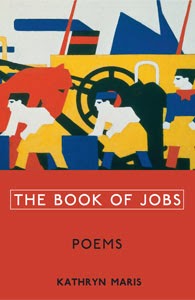
God Loves You was published by Seren in 2013.  The blurb on the back, which you can read here, quotes a couple more favourites.  Maris’ first collection, The Book of Jobs, also very original, was published in the US by Four Way Books; there's a sample here.

. 

Monday, 30 June 2014

Books for one room


My house needs a damp course, all the way round.  The damp course man says there will be a lot of dust, and I need to move books etc upstairs.  There isn’t much etcetera but there are a lot of books, at least in proportion to the house which is two-up two-down with a lean-to kitchen and a bathroom under the stairs.  The house is fine, more than fine; it’s the books that are a problem.  Damp course aside, there is no more space for new ones. 

This has set me thinking about which books I’d keep, if I only had one room.  Strangely that is much, much easier than deciding on a few books to throw out (which from now on I will need to do regularly). 

Looking at two random shelves, both containing mid-20th century non-fiction, I’d keep:

The Endless Steppe by Esther Hautzig.  Jewish girl gets deported from Vilnius to Siberia, in 1941.  This was read aloud to us in English class when we were 10, same age as Esther at the start. 

Age of Extremes by Eric Hobsbawm.  Necessary history.

Homage to Catalonia by George Orwell.  Orwell in the middle of events. 

Bad Blood by Lorna Sage.  About growing up in the Welsh borders, the curse of family: a great read.

Honour, Family, and Patronage: a Study of Institutions and Moral Values in a Greek Mountain Community by J K Campbell.  This anthropological study from the 1950’s was hugely illuminating when I was living in Athens in the 1990’s, trying to understand contemporary Greek politics and society. 

Poetry anthologies are on one long shelf, I’ve got around 70.  I’d keep:

Staying Alive, Being Alive, and Being Human, edited by Neil Astley – the three big Bloodaxe anthologies of 20th and 21st century poetry, which contain large numbers of exceptional poems by a vast range of writers.  The scope, whether poetic, geographical, cultural or emotional, is huge.  The thematic grouping, which could have been a disaster, works really well.  These three would make up for not having room for books of poetry in translation such as The Poetry of Survival, post-war poets of Central and Eastern Europe, edited by Daniel Weissbort.

The Making of a Sonnet – Norton anthology, edited by Edward Hirsch and Eavan Boland.  Formal counterpoint to the largely free verse Bloodaxes, and with poems from Dante onwards. 

The Reality Street Book of Sonnets, edited by Jeff Hilson.  Innovative, inventive sonnets, 20th and 21st century.

Carcanet New Poetries V, edited by Michael Schmidt with Eleanor Crawforth, would be my contemporary British anthology because it’s got a higher-than-usual proportion of strikingly good poems.  Eclectic is another way to go: I’m enjoying a set of four micro-anthologies, blackbird, kingfisher, swift and kestrel, from Sidekick Books, each with half a dozen mostly contemporary poems on the bird in question, and small enough to nestle in the back pocket of my jeans.  Sidekick also produce the full-size Birdbooks. 

Legitimate Dangers, edited by Michael Dumanis and Cate Marvin and published by Sarabande, has to be my contemporary American choice.  It contains work by over 80 poets born after 1960.  This makes it forbiddingly heavy, but it’s where I first read favourites such as Brenda Shaughnessy, Matthea Harvey and D A Powell.  A reserve would be The Best of the Best American poetry, edited by Robert Pinsky, a 2013 selection from all the annual Best anthologies since 1988; plenty of famous names.    

Somehow, I don’t feel the need for anthologies of earlier poetry – maybe because it is in my head anyway.  I don’t mean that I know it off by heart, but that the voices of my favourites, of such as Horace, Shakespeare, Keats, Dickinson, are in my head.    

20th / 21st century single poet collections are much, much harder.  One way of looking at this is to consider which poets I most often pull off the shelf, to read in order to write.  The ones I can think of, in no particular order, form a very small subset:

W S Graham, J H Prynne, Jorie Graham, Mark Doty, Denise Riley, D A Powell, Marie Howe, Jane Kenyon, Paul Celan, George Seferis, Sylvia Plath, Tomas Tranströmer. 

Another way is to consider which new books spend a lot of time out, being read and then read again in a different mood or direction: current examples include Omnesia by W N Herbert, The Visitations by Kathryn Simmonds, and Loom by Sarah Gridley.  

Neither of these methods works.  If it came to one room, I’d ditch nearly all my contemporary novels, in order to keep as much poetry as possible.  (I wouldn’t get an ebook reader: electronic devices put me in work mode.)  As it is, in three weeks’ time I’m going to have to move some books out, temporarily.  I don’t want the upstairs floor to collapse, and there has to be room to sleep.    

Wednesday, 11 June 2014

Poetry and Sexism in the Guardian Review, 2013/14


This has become an annual exercise, or rather a 13-monthly one.  New readers, please see last year’s audit, and also the latest VIDA audit, for the background and reasons for doing this.

2013/14 results:
*  Over a third (37%) of books reviewed are by female poets.  This is the highest percentage yet, and only two points lower than the percentage of women’s books published by the big five poetry publishers.
*  Just over a third (34%) of reviews are written by women. 
*  Middle-sized and small poetry publishers get only 4 books reviewed.  It’s all about the big five.
*  The Guardian is capable of breaking its own glass ceiling: the Saturday Poem has gone gender neutral!
*  Black and Asian poets are very poorly represented in all categories, apparently not at all as reviewers or in the Saturday Poem.
*  The Guardian is reviewing less poetry.

Conclusion:
*  Incremental improvement.  To achieve a Saturday Poem-style breakthrough, the Guardian might have to start reviewing a range of books more representative of the good poetry that’s being published today.       

Figures for May 2013 to early June 2014 are in purple.  Figures for mid March 2012 to end April 2013 are in red.  Figures* for mid February 2011 to early March 2012 are in green.  Figures* from January 2010 - early February 2011 are in blue.  You can access the Guardian’s archive of reviews here.

A.  Books reviewed in the Guardian’s Saturday Review

24 books by men, 14 books by women.  That’s 63% and 37%.
36 books by men, 12 books by women.  That’s 75% and 25%.  
30 books by men, 16 books by women.  That’s 65% and 35%.
27 books by men, 11 books by women.  That’s 71% and 29%. 

Best yet, and a big improvement on last year’s terrible figures.  The split is getting close to the M:F ratio of books published by the big five poetry publishers, which from 2010 to April 2013 was 61:39, see here for the figures on that. 

I think that only 2 books by black and Asian poets were reviewed, the same as last year.  This time the poets were Derek Walcott and Grace Nicholls.  The figure appears disproportionately low.  However, at 5% it’s possible that it might not be far off the percentage for the big five.  It would be good to audit the ethnic origin of poets published by the big five, but this would be much harder than last year’s gender audit.   

See section C below for more on publishers. 

The Guardian Review is reviewing less poetry: see this year’s decline in the number of reviews.  The first two years’ figures above don’t include the short reviews* the Guardian used to do.      

B.  Reviewers

25 men, 13 women.  That’s 66% and 34%.
31 men, 17 women.  That’s 65% and 35%. 
32 men, 14 women.  That’s 70% and 30%.
28 men, 10 women.  That’s 74% and 26%.

The figures consolidate an upward trend, just about.

Female reviewers get given women’s and men’s books to review in roughly equal proportions.  The male reviewers mostly get given books written by men. 

No black or Asian reviewers, I think.  Why not?  
 
C.  Publishers

In this category the figures are even worse than last year.  4 out of 38 books were published by smaller publishers; last year the number was 8.

Again it’s the big five (Bloodaxe Cape, Carcanet, Faber, Picador) who predominate.  There are a few books from larger, non-poetry specialist publishers.  Nothing at all by medium sized, high quality poetry publishers Seren or Salt; there wasn’t last year, either.  The only smaller publishers represented, at one book each, are Shearsman, CB Editions, Polygon and Eggbox Publishing.  Eggbox got in because they published a pamphlet by Faber author and last year’s Forward 1st Collection Prize winner, Sam Riviere. 

British poetry culture has got more diverse, with a range of excellent smaller publishers flourishing and capturing attention.  And there’s the rise of poetry pamphlets; it’s nice that the author of the Eggbox review, David Wheatley, talks a bit about poetry pamphlet culture generally.  But that’s the only concession to these wider changes in the whole year’s Guardian output.     

The Guardian Review’s glass ceiling for smaller publishers is firmly in place. 

D.  Saturday Poem

19 by men and 19 by women.  That’s… 50% and 50%.  Hooray!
23 by men and 13 by women.  That’s 64% and 36%
33 by men and 18 by women.  That’s 65% and 35%.
[I didn’t work this out for 2010.] 

The Guardian can do it!!  Many of the poems chosen are from new collections.  A shame that all the poets are white, at least I think so.    But it’s a start.  Come on, Guardian Saturday Review – make these annual audits unnecessary!  Do this blog out of a job!  First step: start handing out a wider range of review copies.  Then the numbers will improve. 

E.  Audits – what next

The emphasis of this audit is shifing slightly, from the VIDA-inspired gender-only audit that inspired it in the first place to a broader consideration of what lies behind the Guardian Review’s figures. 

The main exercise I want to do, once my inner geek recovers from this one, is an audit of the Poetry Book Society choices and recommendations.  If people have any other ideas, please say.  And do check out the Sidekick Books blog, where Jon Stone has just started a series on how to fix contemporary poetry culture. 
___

* In the first two years, the Guardian also ran short reviews and I counted these separately (they improved the M:F ratio).  There are still occasionally a few short reviews on the paperbacks page, but these don’t appear when one searches the Guardian’s online poetry reviews.  All the figures given in this audit are for long reviews only.  I always include Nicholas Lezard’s paperback review, if this is of a poetry book.

***   ***   ***

Thank you very much to readers of this blog who voted for me in the Saboteur Awards, Best Reviewer category.  The result can be seen at the top right-hand corner of this blog.  Your votes mattered!